
Temporary Sewage Treatment Solutions
Webinar Recording
Recorded: Wednesday 9 April, 13:00 (GMT+1)
When a municipal wastewater plant is overloaded, as is increasingly the case across Ireland, the UK, and internationally, housing developments, hotel projects, and commercial schemes cannot connect to the sewer. The default assumption is that this stalls the development. It doesn't have to. A temporary package sewage treatment plant, correctly designed and consented, can treat sewage on site, discharge to the overloaded municipal plant or a watercourse, and allow a development to proceed, often for a timeline of one to ten years, until the municipal infrastructure is upgraded.
This page contains a full recording of a webinar on temporary sewage treatment solutions, presented by Tommy Butler of BMS, a 40-year Irish manufacturer of package STPs with installations in over 50 countries. Below the recording, you will find a timestamped chapter guide, a written summary of all topics covered, real case studies from Ireland and France, a comprehensive FAQ section, and links to BMS's free design service and Sizing & Selection Handbook.
| Timestamp | Topic | What Is Covered |
|---|---|---|
| 0:00 | Introduction & About BMS | Tommy Butler introduces himself and BMS, 40 years in business, package sewage treatment systems in 50+ countries. |
| 2:00 | When Is Temporary Sewage Treatment Needed? | The four key scenarios: overloaded municipal plant, no available connection, development ahead of infrastructure, work camps and construction sites. |
| 4:16 | Municipal Plant Overloading: The Core Problem | Organic vs hydraulic overloading explained. Why treating on-site and discharging to an overloaded municipal plant can actually improve plant performance. |
| 7:55 | Construction Sites, Oil & Gas, Military & Disaster Relief | Portable solutions for remote sites. Water reuse with UV disinfection. Examples from Bechtel in Algeria and Centre Parcs Longford. |
| 10:15 | How to Design a Package Sewage Treatment Plant | Critical design principles: sizing on organic load, not flow, the flow bias problem, EPA population equivalent tables, and effluent standard selection. |
| 17:10 | Worked Design Example 165-Person Office Building | Step-by-step calculation: BOD load, population equivalent, ammonia removal capacity, phosphorus dosing. Final result: 95 PE plant required. |
| 25:40 | How a Package Wastewater Treatment Plant Works | Process overview: primary settlement, sludge storage, aerobic biological treatment (RBC/biodisc/aeration), final settlement, recirculation. |
| 26:40 | What to Look For in a Temporary STP Solution | Key criteria: plug-and-play, no concrete surround, above- and below-ground, low power, portability, modularity, financing options, setback distances. |
| 28:30 | The BMS Blivet Product Overview | How the Blivet meets all temporary STP criteria. Capacity, power, installation, maintenance, transport, and a 35-year track record. |
| 31:50 | Case Study 1 Large Housing Estate, Arklow, Co. Wicklow | 800 PE phased installation in 3 stages. Irish Water approval. Lessons learned on screening, flow balancing, and construction site maintenance. |
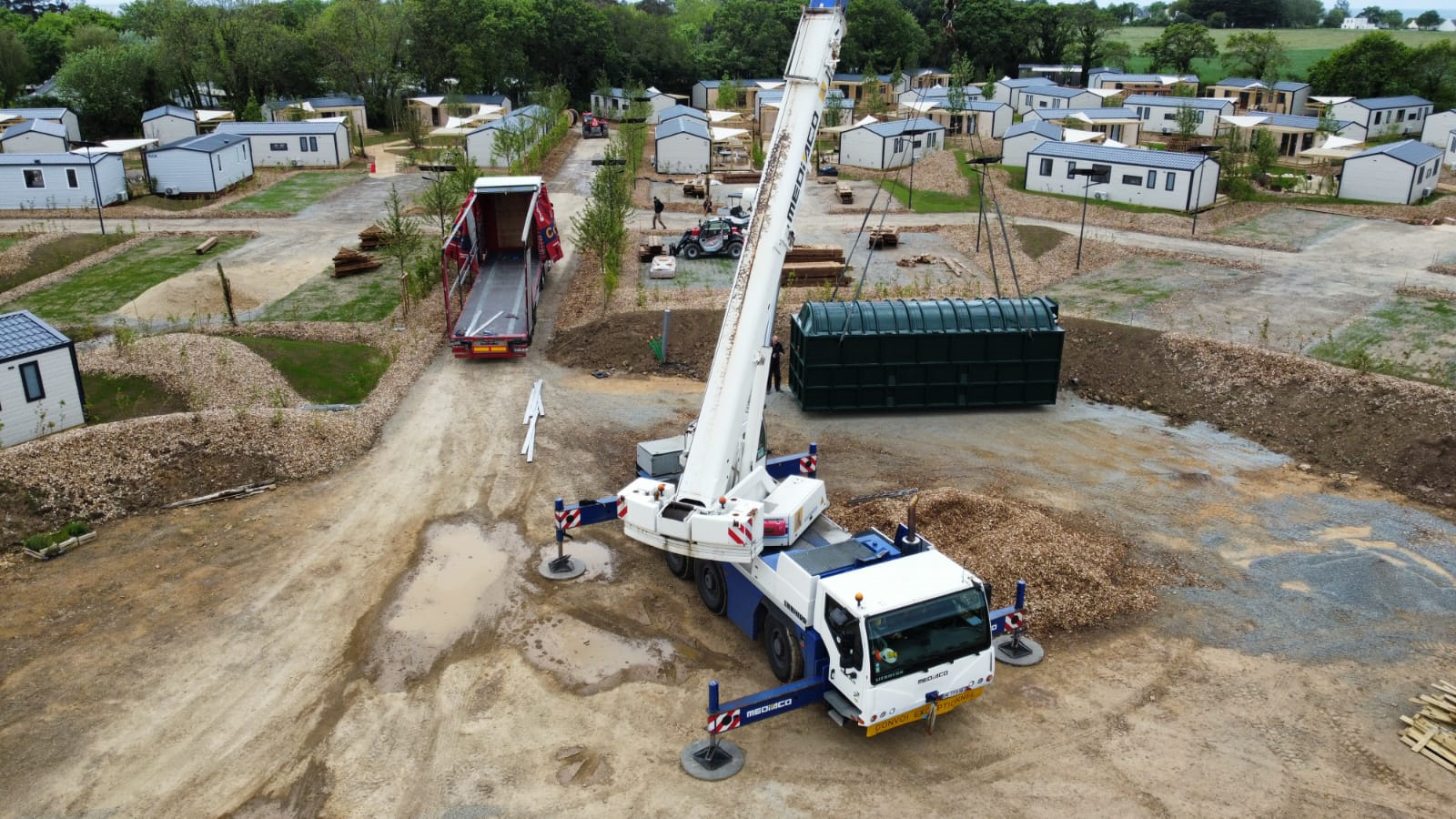
| 37:15 | Case Study 2 Tourist Accommodation & Camping Site, Brittany, France | 750 PE phased installation for seasonal tourism. Higher purchase financing. A 15-year-old refurbished unit redeployed from Lusk. |
| 40:50 | Further Case Studies | Lusk, Co. Dublin (5,000 PE — largest temporary STP to date). Centre Parcs Longford (construction site water reuse). Co. Offaly housing (5m setback in steeltech shed). Newfoundland, Canada (minus 40°C operation). U.S. military camps in Iraq. |
| 43:45 | Conclusion | Summary of when and why temporary STP is the right solution. Planning submissions, design service, and BMS Sizing & Selection Handbook. |
| 45:04 | Q&A Session | Questions answered: maximum plant size, water reuse and odour management, longest operating temporary STP (nearly 15 years), planning submissions, and discharge to watercourse standards. |
Watch To Learn:
How temporary systems work
Compliance, cost, and installation essentials
Case studies of successful projects
How to avoid costly delays
Meet Your Speaker

With years of expertise in wastewater treatment solutions, Tommy has helped countless projects stay on track despite municipal capacity issues.
What This Webinar Covers. Key Topics in Temporary Sewage Treatment
When Is a Temporary Sewage Treatment Plant Required?
There are four main scenarios in which a temporary package STP is the right engineering solution.
First, the municipal wastewater plant is organically overloaded and cannot accept additional BOD, suspended solids, or ammonia load, even if it can still accept additional flow.
Second, there is no available sewer connection at all, either because infrastructure does not exist or because it is under construction and not yet commissioned.
Third, housing or commercial development is being built ahead of municipal infrastructure, a situation seen increasingly in Ireland and internationally, including in Brisbane, Australia, where new towns are planned up to 100km from the city.
Fourth, genuinely temporary applications: oil, gas, and mining work camps, military installations, construction sites, and disaster relief situations where portability and rapid deployment are paramount.
The most common scenario in Ireland is the first: organically overloaded municipal plants. Most are overloaded organically rather than hydraulically,meaning they have capacity for flow volume but not for the pollution load. This distinction is important because it means that if sewage is treated to a specified standard on-site, the treated effluent can be discharged to the sewer. The combined effect actually dilutes and improves the incoming stream at the municipal plant. Irish Water and planning authorities have accepted this arrangement at multiple locations across Ireland.
How to Size a Package Sewage Treatment Plant. The Flow Bias Problem
Sewage treatment plants must be sized on organic load, not flow. This is one of the most common and consequential errors in package STP design. The Irish EPA Population Equivalent table provides flow and BOD values for different building types, from offices and hotels to canteens and function rooms, and should be the starting point for all design calculations.
A practical example illustrates why flow alone is inadequate. An office building with 165 staff produces 4,950 litres of flow per day. Dividing by 200 l/PE/day gives 25 PE. But office staff produce 20g BOD/person/day, a total BOD load of 3,300g/day, equivalent to 55 PE. The plant would be undersized by more than 100% if sized based on flow. The influent BOD concentration in this case is 667 mg/l, more than double the 300 mg/l typical of domestic sewage. A plant sized on flow alone would not meet its discharge standard.
For more complex designs that require ammonia removal, the calculation must also account for the nitrification load. Ammonia-oxidising bacteria are temperature-sensitive and fragile; in a temperate climate like Ireland, removing one gram of ammonia requires four times the oxidative capacity required to remove one gram of BOD. This additional capacity must be added to the BOD-based plant size. Where total nitrogen removal is also required, anoxic denitrification through internal recirculation is needed. Phosphorus removal typically uses ferric or aluminium sulphate dosing, which increases the sludge load and requires an additional 15–20% buffer in plant capacity.
What to Look For in a Temporary Package STP
Not all package sewage treatment systems are suitable for temporary use. The key criteria are:
Plug-and-play installation: inlet and outlet pipe connection and electricity only, commissioning in under one day
No concrete surround required: a system needing a concrete surround cannot be relocated and may have significant decommissioning costs
Above or below ground capability: above ground is fastest to install; below ground enables gravity flow and may suit planning or aesthetic requirements
Low power consumption: sites starting on generator power need a solution that is generator-compatible; an RBC-based system uses 9–20 times less power than a blower-based activated sludge system
Modularity: capacity should be addable in steps to match phased development and spread the capital cost
Portability and resale value: the system must be road-transportable and have a realistic resale or redeployment value after use
Hire purchase financing eligibility: only self-contained all-in-one units can be financed this way; financing requires the system to have an independent asset value
Setback flexibility: systems housed within a ventilated enclosure can achieve setbacks of 5–10 metres from housing rather than the standard 50 metres
Water Reuse with UV Disinfection
On construction sites and in water-scarce locations, adding UV disinfection to a packaged STP converts treated effluent into fully disinfected water suitable for non-potable reuse. Applications include toilet flushing (which accounts for 80–90% of site water use), wheel and road washing, dust suppression, and process water. At Centre Parcs Longford Forest, BMS supplied and operated this system during construction. The payback period was under one year, compared to the cost of tankering untreated sewage off-site. Biodegradable toilet blocks address residual colour or odour when treated water is reused in toilet cisterns.
Case Studies
-
![]()
Large Tourist Accomodation & Camping Site
-
![]()
Large Housing Estate Temporary
-
![]()
Beaufort Institute Temporary

Frequently Asked Questions
-
A single BMS Blivet unit treats up to 500 population equivalents (PE), approximately the size of a 40-foot shipping container, and is the practical maximum for road and international transport. However, the units are fully modular and can be expanded in 500-PE increments. The largest temporary installation BMS has completed to date was 5,000 PE at Lusk, Co. Dublin, where ten units were added in stages as the housing development grew, ahead of the Portrane municipal plant coming on stream.
-
Yes, and this is one of the most common applications in Ireland and internationally. Most municipal plants are organically overloaded rather than hydraulically overloaded, meaning they cannot treat any additional organic load (BOD, suspended solids, ammonia) but can still accept additional flow. If the on-site package STP treats sewage to the required standard, typically BOD 25 mg/l and SS 35 mg/l (European Wastewater Discharge Standard), it can discharge to the sewer. Treated effluent dilutes and improves the incoming load at the municipal plant, benefiting the utility. Irish Water and planning authorities in Ireland have accepted this approach at multiple locations, including Arklow, Middleton, Kingscourt and others.
-
Temporary STPs are typically planned for 1–10 years, with a median of around 3 years in BMS's experience. In practice, they frequently operate longer than originally projected, often because municipal infrastructure upgrades are delayed. The BMS Blivet at Ringaskiddy, Cork, has been operating for nearly 10 years. The Lusk installation operated for nearly 15 years. Units are designed for a 25–30+ year operational life, so extended temporary use does not compromise the asset. Units can be refurbished and redeployed after temporary use, for example, a BL4000 from Lusk was refurbished and is now operating in Brittany, France.
-
Yes, planning permission is typically required. BMS provide a full customised design service suitable for planning submission, including PE calculations, effluent standard confirmation, site layout, civil works specification, and supporting documentation. BMS have prepared planning submissions in Ireland, France, and other jurisdictions. Planning authorities in Ireland have approved temporary STP proposals at multiple locations where housing development is outpacing municipal infrastructure. BMS can assist with responses to planning queries and liaise with Irish Water where a sewer connection or discharge agreement is involved.
-
Discharge to a watercourse requires a licence from the EPA or local authority and typically requires more stringent treatment than discharge to sewer. Standard secondary treatment (BOD ≤25 mg/l, SS ≤35 mg/l) is the minimum. For watercourse discharge, ammonia removal (NH₄ ≤5 mg/l) is commonly required, along with total nitrogen reduction (requiring anoxic denitrification) and phosphorus removal (typically via ferric or aluminium sulphate dosing). Ireland has some of the most stringent effluent discharge standards in Europe, and BMS have extensive experience designing systems to meet these requirements. A receiving water capacity study may also be required.
-
This distinction is critical for designing a temporary STP solution. A hydraulically overloaded plant cannot accept any additional flow volume; the physical pipework, tanks and outfall are at capacity. An organically overloaded plant can accept additional flow but cannot biologically treat any more organic load, BOD, suspended solids, ammonia, or phosphorus. The majority of overloaded municipal plants in Ireland are organically rather than hydraulically overloaded. This means a package STP treating on-site sewage to a standard that removes organic load can discharge its treated effluent to the sewer. The municipal plant handles the hydraulic flow. In contrast, the package plant handles the organic treatment.
-
Biological sewage treatment processes treat organic matter, not water volume. Sizing a plant based solely on flow consistently leads to undersizing. For example, an office building with 165 staff produces 4,950 litres per day of flow, which, divided by 200 l/PE/day, suggests 25 PE. But the actual BOD load from office staff (20g BOD/person/day) amounts to 3,300g BOD/day, equivalent to 55 PE. The plant would be undersized by over 100% if sized on flow alone and would fail to meet discharge standards. The Irish EPA population equivalent table provides flow and BOD/SS values for a wide range of building types and should be used for all initial sizing.
-
Yes. With the addition of UV disinfection at the end of the treatment process, treated effluent from a BMS Blivet meets the standard for non-potable reuse. On construction sites, this has been used for toilet flushing (80–90% of site water use), wheel and road washing, dust suppression, and road cleaning. BMS supplied and operated this solution at Centre Parcs Longford Forest during construction by Sisk and Roadbridge, with a payback period of under one year compared to tankering untreated sewage. Biodegradable toilet blocks eliminate any residual colour or odour when treated water is reused for flushing.
-
Standard guidance recommends a setback of approximately 50 metres from housing. However, setbacks can be significantly reduced with the right system and mitigation. BMS installed two BL4000 Blivet units in Co. Offaly, just 5 metres from houses, by housing them in a ventilated Steeltech-type agricultural shed, eliminating odour impact. Residents were reportedly unaware that the units were present. The shed approach is a practical solution where site constraints make standard setbacks impossible.
-
Yes, and this is one of the key advantages of an all-in-one package STP over a built-in-situ system. Because the BMS Blivet is a self-contained manufactured unit with a resale value, it can be financed by hire purchase, spreading the capital cost over the operational period. This is particularly relevant for housing and commercial developers, where cash flow management is critical. Hire purchase financing is only available for self-contained portable units — systems requiring concrete surrounds or permanent civil installation cannot be financed in this way.
-
Once the municipal plant is upgraded or a sewer connection becomes available, the temporary STP is decommissioned. For a BMS Blivet, this involves: fully emptying the unit via a suction tanker, disconnecting the inlet and outlet pipework and electrical connections, and lifting the unit from its position. If installed above ground or without a concrete surround, there are minimal civil decommissioning works. The unit can then be sold on, relocated to another site, or refurbished for reuse. Units retain significant resale value, for example, a 15-year-old BL4000 from Lusk was refurbished and redeployed to Brittany, France. A BL2000 from the same project is now operating in Mayotte in the Indian Ocean.
-
Once the municipal plant is upgraded or a sewer connection becomes available, the temporary STP is decommissioned. For a BMS Blivet, this involves: fully emptying the unit via a suction tanker, disconnecting the inlet and outlet pipework and electrical connections, and lifting the unit from its position. If installed above ground or without a concrete surround, there are minimal civil decommissioning works. The unit can then be sold on, relocated to another site, or refurbished for reuse. Units retain significant resale value, for example, a 15-year-old BL4000 from Lusk was refurbished and redeployed to Brittany, France. A BL2000 from the same project is now operating in Mayotte in the Indian Ocean.
-
Yes. Biological sewage treatment functions in very cold conditions because sewage temperature is typically warmer than ambient air temperature in cold climates. BMS have operated Blivet systems in Newfoundland, Canada, at temperatures down to minus 40°C, and in the Middle East at temperatures over plus 35°C. The biological process slows in cold conditions but does not stop, provided adequate sewage flow is maintained. Additional insulation or housing may be considered for extreme environments.

Got A Question? – Contact Us Below!
About BMS
Butler Manufacturing Services (BMS) is a leading provider of modular sewage treatment solutions designed to help developers navigate infrastructure challenges efficiently and cost-effectively.