How to Design/Select a Package Sewage Treatment Plant Webinar
Introduction
Designing and selecting the right package sewage treatment plant is one of the most commonly misunderstood tasks in civil and environmental engineering. Get the sizing wrong most often by sizing on flow rather than organic load, and the plant will fail to meet its discharge licence from day one. Get the discharge standard wrong, and you will have specified the wrong technology entirely.
This free webinar, presented by Tommy Butler of BMS, covers the full design process from first principles: calculating BOD, COD, suspended solids and ammonia loads; working with EPA population equivalent tables; sizing for nutrient removal (ammonia, total nitrogen, phosphorus); understanding how discharge destination dictates effluent standard; and selecting the right package STP configuration for your project. A full worked design calculation takes a mixed-use development through to a complete plant specification. BMS has been manufacturing and installing packaged sewage treatment systems for 40 years across 50+ countries. The oldest BMS plant still in operation is 38 years old. This webinar draws on that experience to give engineers and designers a practical, applicable understanding of package STP design,ranging from a 20-PE rural hotel to a 1,000-PE mixed development with full nutrient removal.
WHO IS PRESENTING
Key Speaker is Tommy Butler
An experienced cross-disciplinary professional with a background in environmental services, pharmacy and sport. Tommy brings strong operational expertise across marketing, digital media, content creation, R&D, negotiation, business planning, project management, sales and market analysis. Tommy is highly adaptable, with a proven ability to quickly acquire new skills, supported by an MBS in Management Practice and an MPharm in Pharmacy. With extensive hands-on experience in wastewater treatment systems, Tommy has successfully delivered complex projects despite municipal capacity constraints.
You can contact Tommy to discuss your Sewage Treatment Project by emailing: info@butlerms.com or ringing +3534326100
| Timestamp | Topic | What Is Covered |
|---|---|---|
| 0:11 | Introduction & About BMS | Tommy Butler introduces himself and BMS, 40 years in business, package sewage treatment systems in 60+ countries. |
| 2:26 | Where to Start: The Four Design Questions | Source of sewage; required discharge standard; temporary or permanent; grease traps, phased development, domestic vs industrial sewage. Sizing is always on max biological load, never flow. |
| 5:47 | Sewage Treatment Terminology | Population equivalent (PE), BOD, COD, suspended solids — what they mean, how they are measured, and typical inlet concentrations. Why is COD useful as a quick proxy for BOD? |
| 13:24 | Flow, Flow Bias & Flow Patterns | Why sizing on flow alone consistently underestimates plant requirements. Dry weather flow explained. Surface water infiltration. Flow peaks in hotels vs housing. The balance tank is a solution to peak flows. |
| 18:40 | Ammonia, Total Nitrogen & Phosphorus Advanced Treatment | Why ammonia removal requires 3–4× the oxidative capacity of BOD removal. Biological anoxic denitrification for total nitrogen. Chemical precipitation (ferric/aluminium sulphate) for phosphorus. Effluent standards for different discharge scenarios. |
| 25:47 | Worked on Design Calculation Mixed-Use Development | Full step-by-step calculation for a development with 51×1-bed apartments, 52×2-bed apartments, a café/restaurant and retail units. Outlet standard: BOD 10, SS 10, NH₄ 5, TN 15, P 2. Final result: 641 PE plant required. |
| 34:17 | How a Package Wastewater Treatment Plant Works | Process overview: primary settlement, sludge storage, aerobic biological treatment (RBC/biodisc/aeration), final settlement, recirculation. |
| 39:41 | The BMS Blivet Technology Overview | Lamella plate settlers for compact settlement. BMS Aerotor next-generation RBC/biodisc. Plug flow guarantee. Adjustable gravity recirculation for nutrient removal. 0.75 kW motor + sludge return pump only. 40ft container transport. Modular expansion. |
| 43:59 | Add-Ons Balance/Screening Tank, Tertiary Filter, UV Disinfection | Balance and screening tank: 8–12-hour capacity, macerator pumps on a timer, full-length baffle for solids capture, denitrification zone. BMS M10 tertiary polishing filter (Filtrite media) for BOD/SS ≤10 mg/l. UV disinfection for reuse. |
| 46.42 | What to Look For in a Package STP | Design track record and references. All-in-one plug-and-play vs separate component systems. Above/below ground capability. Low power and maintenance. Modular phases. Whole-life cost vs first cost. |
| 48.31 | Case Studies | Housing: 416 PE, single BL4000 unit. Tourism, France (phased): 250 PE then 500 PE, 15-year-old refurbished unit redeployed to Mayotte. Five-star hotel, reservoir discharge: BOD/SS 5, NH₄ 2, TN 14, P 2, UV, 926 PE across multiple BL4000 units and polishing filters. Caribbean (Sint Maarten): three × 500 PE flow split. Canada: 400 PE township in extreme cold. Clonmacnoise monastic site, Ireland: seasonal flow from 3,000 to 50 visitors/day. |
| 54.15 | Conclusion & Q&A | Design summary: calculate organic load, determine discharge standard, select system. Q&A covers: hotel BOD blending (Guyana/Hayatt), oldest plant (38 years), first cost vs whole-life cost comparison (Trinidad & Tobago). |
CAN’T FIND WHAT YOU ARE LOOKING FOR?
Talk To Us Today
At Butler Manufacturing Services, our staff and engineering teams are always ready and eager to help with any enquiry you might have. Whether you need guidance on product specifications or require a customized solution, our team is here to lend a helping hand.
What This Webinar Covers — A Complete Guide to Package STP Design
Where to Start. The Four Design Questions
Every STP design starts with four questions.
What is the source of the sewage? The source determines the organic load concentration; housing is the most predictable, while offices, canteens, and hotels can produce influent at two to four times the normal BOD concentration for the same flow volume.
What effluent standard is required? This is dictated by where the treated sewage is discharged, percolation, sewer, watercourse, marine environment, or reuse and by the regulatory authority’s licence conditions.
Is the plant temporary or permanent? This affects specification, portability requirements, and financing options.
Are there grease traps, phased development, or industrial inputs to consider?
One principle overrides all others: sizing is always based on the maximum biological load, never the flow. This is the single most common error in package STP design and the primary cause of plants being installed that cannot meet their discharge licence.
The Flow Bias Problem. Why Flow Alone Is Not Enough
The flow bias problem arises when a designer calculates the total daily flow and divides it by 200 l/PE/day to determine a plant size. This gives the hydraulic PE, but the organic PE determines which plant is needed. For domestic housing, the two are closely aligned. For offices, canteens, restaurants, and hotels, the differences are significant.
In the worked example presented in the webinar, a café/restaurant produces 30 litres of flow per person per day, the same BOD load as a full-time resident, but in less than one-sixth the flow volume. The resulting BOD concentration is 670 mg/l, more than double the 300 mg/l of normal domestic sewage. A flow-based calculation would have indicated that the plant is 27% undersized for this mixed-use development. In a simpler office building, the undersizing can exceed 100%.
Discharge Standards. What Destination Dictates
The receiving environment and the regulatory authority determine the required effluent standard. Standard secondary treatment, BOD 25 mg/l, SS 35 mg/l, is the minimum baseline and is sufficient for discharge to percolation or an organically overloaded municipal sewer. Discharge to a watercourse typically requires ammonia removal (NH₄ ≤5 mg/l) and, in many Irish EPA licences, total nitrogen (≤15–50 mg/l) and phosphorus (≤2 mg/l) removal. Marine and reservoir discharges are subject to the strictest standards, with BOD/SS as low as 5 mg/l and full disinfection.
For reuse, particularly irrigation, the approach differs. BOD and SS should be minimised, and UV disinfection should be applied. Still, ammonia, nitrogen, and phosphorus can be usefully retained, as the treated water functions as a dilute fertiliser when applied to soil. Spending money on nutrient removal for an irrigation application is therefore counterproductive.
Ammonia and Nutrient Removal — The Sizing Impact
Adding ammonia removal to a plant specification significantly increases the required plant size. Ammonia-oxidising bacteria (nitrifiers) are both temperature-sensitive and fragile. They require 3–4 times the oxidative capacity per gram of pollutant as BOD-removal bacteria. In temperate climates (Ireland, UK, northern Europe), apply a multiplier of 4; in warm climates (Caribbean, Australia), apply a multiplier of 3. This means that for a plant designed to a standard of NH₄ ≤5 mg/l in Ireland, the ammonia removal load may add 40–60% to the base BOD plant size.
Reducing total nitrogen requires an additional step: biological anoxic denitrification. Nitrification converts ammonia to nitrate; denitrification converts nitrate to nitrogen gas. The process requires an anaerobic (anoxic) tank upstream or within the system that receives recirculated nitrate-rich effluent mixed with incoming raw sewage. A 50% recirculation rate and 8 hours hydraulic retention in the anoxic zone is typical. Phosphorus removal is achieved by dosing ferric or aluminium sulphate into the primary settlement tank; both are biocidal and bulk the sludge, requiring a 20–25% additional plant capacity buffer.
How the BMS Blivet Achieves Treatment
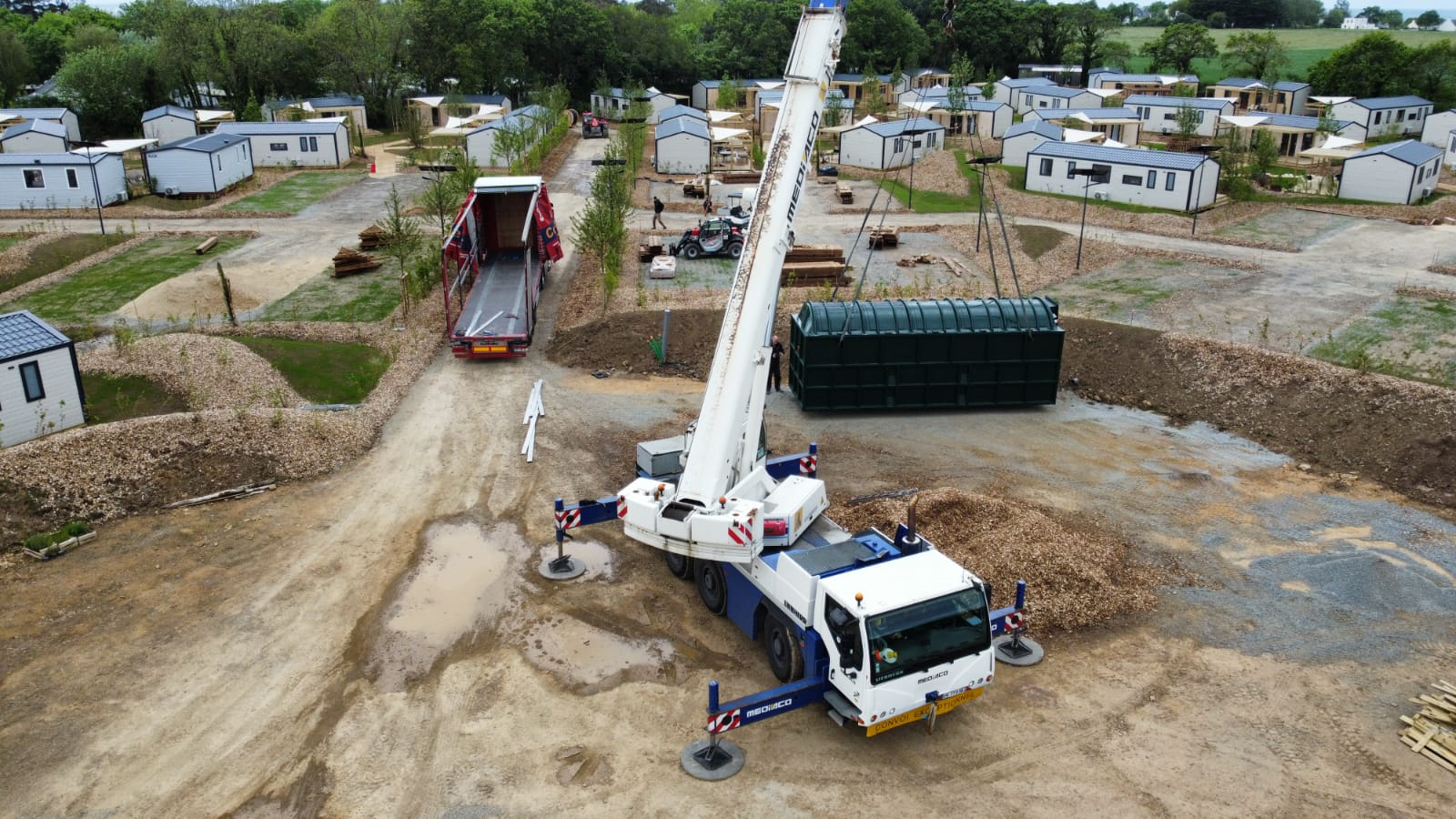
The Blivet integrates primary settlement, biological treatment, final settlement, and sludge storage in a single prefabricated GRP tank. Lamella plate settlers in both the primary and final settlement zones provide three times the settlement surface area of conventional tanks within the same volume — the main contributor to the Blivet’s compact footprint. The BMS Aerotor RBC/biodisc provides active aeration and fixed-film biological treatment, with 97% of its surface area inside the drum, in a plug-flow configuration that ensures every litre of sewage passes fully through the biological stage before progressing.
The Aerotor does not require a minimum MLSS to operate, making it significantly more robust under variable load and low-flow conditions than activated sludge systems. Gravity recirculation from outlet to inlet is adjustable and can be used to provide denitrification capacity within the unit. Power consumption is 8–15 kWh/day for a 0.75 kW continuous motor and a sludge-return pump running for 4 minutes per hour, making it generator-compatible and the lowest-power option available for a package STP at this scale.
Add-On Components. Balance Tank, Polishing Filter, UV
Three add-on components extend the Blivet’s capability for more demanding applications. A balance and screening tank upstream provides flow balancing (8–12 hours capacity), gross solids capture via a full-length baffle and macerator pumps, and — if configured as an anoxic zone — denitrification capacity with recirculation. This is particularly valuable for hotels, tourism facilities, and multi-phase housing developments with flow surges. The BMS M10 tertiary polishing filter uses Filtrite desiccated clay media to reduce BOD and SS to levels below those achieved by secondary biological treatment alone — typically to ≤10 mg/l or lower. It backwashes automatically and requires minimal maintenance. UV disinfection added downstream of the polishing filter produces water suitable for non-potable reuse, irrigation, or discharge to the most sensitive environments.
SEWAGE TREATMENT TERMINOLOGY
| Term | Unit | Meaning | Typical Value |
|---|---|---|---|
| BOD (Biochemical Oxygen Demand) | Mg/L or G/Day | Pollution potential of sewage. Measured over 5 days. ~300 mg/l typical inlet. | 60 g/PE/day / Inlet:300 mg/l Outlet 25 mg/l |
| COD (Chemical Oxygen Demand) | Mg/L or G/Day | Total oxygen demand, including non-biodegradable fraction. ~2–3× BOD. Quick test. | 120 g/PE/day / Inlet 600-900 mg/l Outlet 75-150 mg/l |
| Suspended Solids (SS) | Mg/L or G/Day | Population equivalent (PE), BOD, COD, suspended solids — what they mean, how they are measured, and typical inlet concentrations. Why is COD useful as a quick proxy for BOD? | 60 g/PE/day / Inlet:300-400 mg/l Outlet 25-35 mg/l |
| Population Equivalent (PE) | Mg/L or G/Day | Unit for sizing WWTP/STPs. 1 PE = 1 Full Time Resident. | 60 g BOD/SS, 120 g COD, 8g N/NH4, 2.8g P, 200 l Flow/PE/day |
| Ammonia NH4 | Mg/L or G/Day | Why ammonia removal requires 3–4× the oxidative capacity of BOD removal. Biological anoxic denitrification for total nitrogen. | 8 g/PE/day Inlet 40-100 mg/l Outlet 1-20 mg/l |
| Total Nitrogen (TN) | Mg/L or G/Day | Ammonia + nitrate + organic nitrogen. Requires denitrification to reduce | 8 g/PE/day Inlet 40-100 mg/l Outlet 15-50 mg/l |
| Phosphorus (P)/(OP) | Mg/L or G/Day | Mainly from detergents. Removed by chemical dosing (Ferric/Aluminium Sulphate). | 2.8 g/PE/day. Inlet 10-20 mg/l Outlet 1-10 mg/l. |
| Dry Weather Flow (DWF) | Litres (L) | Sewage flow without surface water infiltration. True design flow basis. | ~200 l/PE/day (varies between countries) |
| Upward Flow Velocity | Metres/Hour (m/h) | Settlement tank design parameter. Must stay below 0.9 m/hr to prevent solids carryover. Calculated by dividing the flow in m4 by the surface area of the settlement tank in m2. Lamellae Plates Settlers used in the BMS provide three times the surface area for settlement in a given space compared to a traditional settlement tank. | 60 g/PE/day |
| Plug Flow | - | All sewage passes through the biological treatment stage before proceeding. Guarantees 100% contact. | A unique design feature of the BMS Aerotor next generation RBC |
| Nitrification | Case Studies | A Process where Ammonia (NH4) is converted to Nitrate (NO3). This will only take place after BOD/SS are treated. It does not lower the the Total Nitrogen (N2), which require Anoxic Denitrification. | Inlet 40-100 mg/l Outlet 5-20 mg/l |
| Anoxic Denitrification | Case Studies | A Process where heterotrophic, facultative anaerobic bacteria converted Nitrate to Nitrogen and Oxygen Gas. The process lowers Total Nitrogen. It only takes place after Nitrification where Ammonia (NH4) is converted to Nitrate (NO3) by Nitrification | Inlet 40-100 mg/l Outlet 15-40 mg |
| Mixed Liqour Suspended Solids (MLSS) | Conclusion & Q&A | Minimum biomass concentration for activated sludge systems. Not required by RBC/fixed-film systems. | The BMS Aerotor/Blivet does not require a minimum MLSS. |
CAN’T FIND WHAT YOU ARE LOOKING FOR?
Talk To Us Today
At Butler Manufacturing Services, our staff and engineering teams are always ready and eager to help with any enquiry you might have. Whether you need guidance on product specifications or require a customized solution, our team is here to lend a helping hand.
Case Studies
-
![]()
Large Tourist Accomodation & Camping Site
-
![]()
Large Housing Estate Temporary
-
![]()
Beaufort Institute Temporary

Frequently Asked Questions
-
A single BMS Blivet unit treats up to 500 population equivalents (PE), approximately the size of a 40-foot shipping container, and is the practical maximum for road and international transport. However, the units are fully modular and can be expanded in 500-PE increments. The largest temporary installation BMS has completed to date was 5,000 PE at Lusk, Co. Dublin, where ten units were added in stages as the housing development grew, ahead of the Portrane municipal plant coming on stream.
-
Yes, and this is one of the most common applications in Ireland and internationally. Most municipal plants are organically overloaded rather than hydraulically overloaded, meaning they cannot treat any additional organic load (BOD, suspended solids, ammonia) but can still accept additional flow. If the on-site package STP treats sewage to the required standard, typically BOD 25 mg/l and SS 35 mg/l (European Wastewater Discharge Standard), it can discharge to the sewer. Treated effluent dilutes and improves the incoming load at the municipal plant, benefiting the utility. Irish Water and planning authorities in Ireland have accepted this approach at multiple locations, including Arklow, Middleton, Kingscourt and others.
-
Temporary STPs are typically planned for 1–10 years, with a median of around 3 years in BMS's experience. In practice, they frequently operate longer than originally projected, often because municipal infrastructure upgrades are delayed. The BMS Blivet at Ringaskiddy, Cork, has been operating for nearly 10 years. The Lusk installation operated for nearly 15 years. Units are designed for a 25–30+ year operational life, so extended temporary use does not compromise the asset. Units can be refurbished and redeployed after temporary use, for example, a BL4000 from Lusk was refurbished and is now operating in Brittany, France.
-
Yes, planning permission is typically required. BMS provide a full customised design service suitable for planning submission, including PE calculations, effluent standard confirmation, site layout, civil works specification, and supporting documentation. BMS have prepared planning submissions in Ireland, France, and other jurisdictions. Planning authorities in Ireland have approved temporary STP proposals at multiple locations where housing development is outpacing municipal infrastructure. BMS can assist with responses to planning queries and liaise with Irish Water where a sewer connection or discharge agreement is involved.
-
Discharge to a watercourse requires a licence from the EPA or local authority and typically requires more stringent treatment than discharge to sewer. Standard secondary treatment (BOD ≤25 mg/l, SS ≤35 mg/l) is the minimum. For watercourse discharge, ammonia removal (NH₄ ≤5 mg/l) is commonly required, along with total nitrogen reduction (requiring anoxic denitrification) and phosphorus removal (typically via ferric or aluminium sulphate dosing). Ireland has some of the most stringent effluent discharge standards in Europe, and BMS have extensive experience designing systems to meet these requirements. A receiving water capacity study may also be required.
-
This distinction is critical for designing a temporary STP solution. A hydraulically overloaded plant cannot accept any additional flow volume; the physical pipework, tanks and outfall are at capacity. An organically overloaded plant can accept additional flow but cannot biologically treat any more organic load, BOD, suspended solids, ammonia, or phosphorus. The majority of overloaded municipal plants in Ireland are organically rather than hydraulically overloaded. This means a package STP treating on-site sewage to a standard that removes organic load can discharge its treated effluent to the sewer. The municipal plant handles the hydraulic flow. In contrast, the package plant handles the organic treatment.
-
Biological sewage treatment processes treat organic matter, not water volume. Sizing a plant based solely on flow consistently leads to undersizing. For example, an office building with 165 staff produces 4,950 litres per day of flow, which, divided by 200 l/PE/day, suggests 25 PE. But the actual BOD load from office staff (20g BOD/person/day) amounts to 3,300g BOD/day, equivalent to 55 PE. The plant would be undersized by over 100% if sized on flow alone and would fail to meet discharge standards. The Irish EPA population equivalent table provides flow and BOD/SS values for a wide range of building types and should be used for all initial sizing.
-
Yes. With the addition of UV disinfection at the end of the treatment process, treated effluent from a BMS Blivet meets the standard for non-potable reuse. On construction sites, this has been used for toilet flushing (80–90% of site water use), wheel and road washing, dust suppression, and road cleaning. BMS supplied and operated this solution at Centre Parcs Longford Forest during construction by Sisk and Roadbridge, with a payback period of under one year compared to tankering untreated sewage. Biodegradable toilet blocks eliminate any residual colour or odour when treated water is reused for flushing.
-
Standard guidance recommends a setback of approximately 50 metres from housing. However, setbacks can be significantly reduced with the right system and mitigation. BMS installed two BL4000 Blivet units in Co. Offaly, just 5 metres from houses, by housing them in a ventilated Steeltech-type agricultural shed, eliminating odour impact. Residents were reportedly unaware that the units were present. The shed approach is a practical solution where site constraints make standard setbacks impossible.
-
Yes, and this is one of the key advantages of an all-in-one package STP over a built-in-situ system. Because the BMS Blivet is a self-contained manufactured unit with a resale value, it can be financed by hire purchase, spreading the capital cost over the operational period. This is particularly relevant for housing and commercial developers, where cash flow management is critical. Hire purchase financing is only available for self-contained portable units — systems requiring concrete surrounds or permanent civil installation cannot be financed in this way.
-
Once the municipal plant is upgraded or a sewer connection becomes available, the temporary STP is decommissioned. For a BMS Blivet, this involves: fully emptying the unit via a suction tanker, disconnecting the inlet and outlet pipework and electrical connections, and lifting the unit from its position. If installed above ground or without a concrete surround, there are minimal civil decommissioning works. The unit can then be sold on, relocated to another site, or refurbished for reuse. Units retain significant resale value, for example, a 15-year-old BL4000 from Lusk was refurbished and redeployed to Brittany, France. A BL2000 from the same project is now operating in Mayotte in the Indian Ocean.
-
Yes. Biological sewage treatment functions in very cold conditions because sewage temperature is typically warmer than ambient air temperature in cold climates. BMS have operated Blivet systems in Newfoundland, Canada, at temperatures down to minus 40°C, and in the Middle East at temperatures over plus 35°C. The biological process slows in cold conditions but does not stop, provided adequate sewage flow is maintained. Additional insulation or housing may be considered for extreme environments.
Not finding what you are looking for? Let’s search for it!
Our company specializes in creating tailor-made solutions for treating sewage, surface water, and wastewater. If you have a unique idea, please get in touch with us and let's explore it together.